Endemic vs. epidemic bark beetle populations: where the line sits
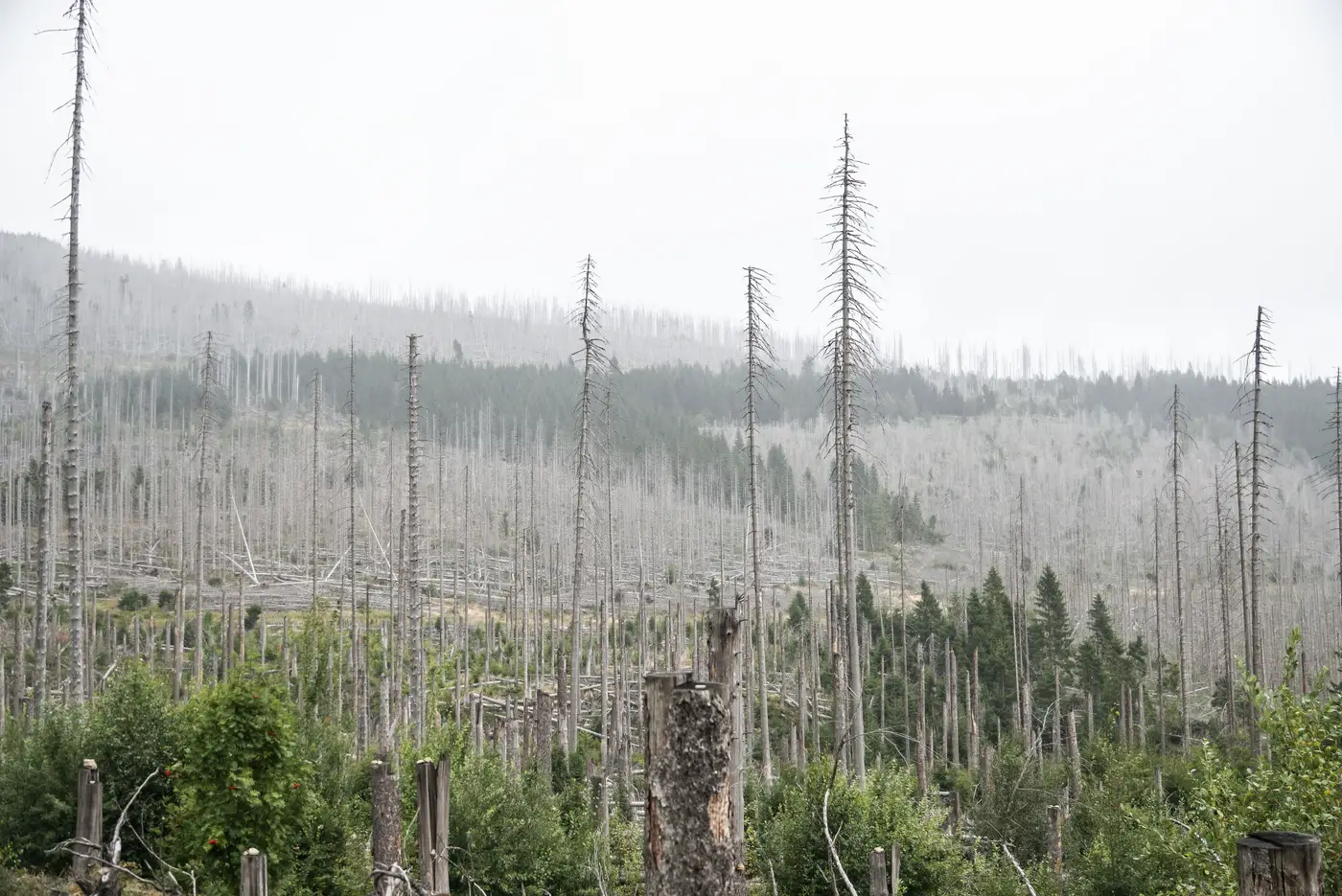
Every regional specialist has had this conversation with a district silviculturist: "Is this an outbreak, or is it just background mortality?" Endemic and epidemic are points on the same population curve. Where a stand sits on that curve determines what you do next.
What endemic actually means on the ground
At endemic levels, bark beetles are doing what they've always done: killing stressed, suppressed, or injured trees one at a time, scattered through the stand. You'll see single red-top trees here and there, maybe a lightning-struck pine or a drought-stunted spruce with pitch tubes and frass at the base. Brood production is low because host material is limited. The beetles aren't choosing healthy, vigorous trees because they can't overcome a tree's resin defenses in enough numbers to succeed.
Most forest health programs treat this as background noise. It shows up in annual aerial detection survey (ADS) data as light, scattered mortality, usually well under a tree or two per acre in affected polygons. No one pulls together a response plan for endemic mortality. It's the cost of running a forest.
Where epidemic starts, and why the threshold moves
Epidemic, or outbreak, status is declared when the beetle population has grown large enough to mass-attack and overwhelm healthy, full-vigor trees in groups, not just the weak ones. The mechanism is aggregation pheromones: once enough beetles bore into a host and release attractant chemicals, they recruit more beetles faster than the tree can pitch them out. That's the switch that turns scattered single-tree kill into expanding multi-tree groups, and eventually into whole drainage-level mortality fronts.
There isn't one national number that flips the switch. Thresholds are set agency by agency, and they're built from a combination of inputs:
- Trend in ADS polygon counts year over year, particularly acceleration rather than raw count
- Trap catch data from pheromone-baited funnel traps, where a jump in beetles per trap per week flags a building population
- Ground plot infestation rates, infested trees per acre within a fixed-radius or variable-radius plot
- Stand susceptibility indices, basal area, host species composition, average stand age, and phloem thickness, which predict how much fuel is sitting there for the population to run on
- Drought and stress indicators, since water-stressed stands lower the beetle pressure needed to succeed
Some state programs use a formal rating, something like "incipient, building, epidemic," tied to specific beetles-per-trap or infested-trees-per-acre cutoffs written into their forest health protocols. Others leave the call to a regional entomologist's judgment, weighing the trend line over several readings. Either way, the declaration typically comes after two consecutive seasons of population growth.
Why the stage matters more than the label
For salvage harvest prioritization, the endemic/epidemic label is really a proxy for a more useful question: how far has infestation progressed within a given stand, and is it still spreading? A stand can be officially "epidemic" at the district level while individual stands inside it sit anywhere from first-year red-attack to fully grey-attack and already salvaged by someone else. Waiting for the next aerial survey window to find out which is which costs a season you don't get back, especially once grey-attack sets in and merchantability starts dropping.
That's the gap a monthly spectral read on infestation stage is built to close, scoring red-attack to grey-attack progression stand by stand so your crews aren't guessing which polygons from last year's outbreak declaration are still worth a salvage sale and which have aged past it.
If your program is still stacking trap counts against last year's ADS flight to figure out which stands moved from building to epidemic, a stage-by-stand register gets you there faster.